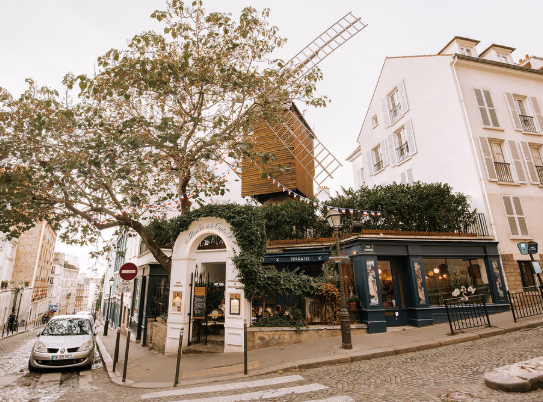
The Century-Old Artistic Heritage of Montmartre
Perched high above the sprawling metropolis of Paris, the iconic hilltop neighborhood of Montmartre remains a living testament to the Bohemian revolution of the late 19th and early 20th centuries. Long before it became a bustling tourist destination crowned by the gleaming white domes of the Sacré-Cœur Basilica, Montmartre was a humble, rural village dotted with windmills and vineyards. Its affordable rents and sweeping views of the city below naturally attracted a vanguard of impoverished but brilliantly innovative artists, transforming the district into the undisputed epicenter of global creativity.
Tracing the Footsteps of Van Gogh and Picasso
To truly understand Montmartre, one must look beyond the main thoroughfares and delve into the quiet cobblestone alleys where modern art was fundamentally reshaped. During the Belle Époque, this neighborhood served as the stomping ground for artistic titans such as Vincent van Gogh, Henri de Toulouse-Lautrec, and Amedeo Modigliani. The Bateau-Lavoir, a dark, creaky, and notoriously drafty building on Rue Ravignan, became the legendary incubator for the Cubist movement. It was within these very walls that a young Pablo Picasso painted his groundbreaking masterpiece, “Les Demoiselles d’Avignon,” forever altering the trajectory of visual arts.
- The Van Gogh Connection: Vincent van Gogh lived with his brother Theo on Rue Lepic. The vibrant colors and dynamic brushstrokes of his Parisian period were heavily influenced by the distinct light and bustling café culture of Montmartre.
- Cabaret Culture: Establishments like Le Chat Noir and the Moulin de la Galette were not merely entertainment venues; they were crucial networking hubs where artists, writers, and intellectuals exchanged radical ideas over glasses of absinthe.
These historical touchpoints are not relegated to the past. Visitors today can still walk the exact routes these masters took, observing the preservation of the architecture that framed their daily lives. The local government has gone to great lengths to ensure that the structural integrity and historical plaques of these studios remain intact, offering a tangible connection to the ghosts of art history.
The Vibrant Modern Street Painters of Place du Tertre
While the original masters have long since passed, the artistic lifeblood of Montmartre continues to pump vigorously through the veins of Place du Tertre. This bustling square, located just a stone’s throw from the Sacré-Cœur, is famously packed with easels, palettes, and contemporary street painters. Far from being a mere tourist trap, the square operates under strict municipal regulations to preserve its authenticity.
Artists seeking a coveted 1-square-meter plot in Place du Tertre must undergo a rigorous application process through the Mairie de Paris (Paris City Hall). They are required to prove their artistic credentials and must strictly create original works—no mass-produced prints are allowed. This ensures that when visitors commission a portrait or purchase a landscape, they are directly supporting a highly skilled artisan who is actively continuing Montmartre’s century-old legacy of open-air creation.

Unveiling the Romance and Masterpieces of the Musée d’Orsay
If the Louvre is the sprawling, encyclopedic grandfather of Parisian museums, the Musée d’Orsay is its deeply romantic, specialized counterpart. Nestled gracefully on the Left Bank of the Seine, this museum houses the largest and most comprehensive collection of Impressionist and Post-Impressionist masterpieces in the world. However, the art hanging on the walls is only half of the story; the building itself is a monumental work of architectural brilliance that perfectly frames the transition from classical tradition to modern innovation.
The Architectural Transformation: From Railway to Art Haven
The Musée d’Orsay’s unique charm is inextricably linked to its origins as a Beaux-Arts railway station, the Gare d’Orsay, constructed for the 1900 Exposition Universelle. Designed by architect Victor Laloux, the station was a marvel of industrial engineering masked by an elegant stone facade. By the late 1930s, however, the platforms had become too short for modern electric trains, and the building fell into disuse. It narrowly escaped demolition in the 1970s before being brilliantly repurposed into a museum, opening its doors to the public in 1986.
The genius of the museum’s design lies in its utilization of the original station’s massive glass barrel vault. This architectural feature floods the central nave with natural light, creating an unparalleled viewing environment for the art. The iconic, giant ornate clocks that once dictated the frantic schedules of travelers now stand as silent, romantic sentinels, offering visitors stunning, silhouette-framed views of the Seine and the Sacré-Cœur in the distance.
Navigating the Impressionist Collections
The collection spans the incredibly fertile artistic period from 1848 to 1914. This era witnessed a radical departure from the rigid, state-sponsored academic art of the Salon, moving toward capturing the fleeting effects of light, everyday life, and raw human emotion.
- Claude Monet and the Birth of Impressionism: The museum houses pivotal works by Monet, including his ethereal series of the Rouen Cathedral and the water lilies, showcasing his obsession with atmospheric conditions.
- Vincent van Gogh’s Intense Emotion: The dedicated Van Gogh gallery is a profoundly moving experience. Masterpieces like “Starry Night Over the Rhône” and his mesmerizing “Self-Portrait” reveal the artist’s turbulent psychological state through thick, swirling impasto.
- Pierre-Auguste Renoir’s Joyful Realism: “Bal du moulin de la Galette” captures a vibrant Sunday afternoon in Montmartre, perfectly encapsulating the joy and social dynamism of 19th-century Parisian life.
To fully absorb the narrative of the Musée d’Orsay, visitors should begin on the ground floor to understand the academic foundations, then ascend to the upper galleries where the explosion of Impressionist color and light takes center stage. This chronological approach provides a deeply satisfying understanding of how a small group of rebellious painters forever changed how humanity sees the world.

Mastering the Louvre: Strategies to Avoid Crowds
The Musée du Louvre is a cultural behemoth. Spanning over 60,000 square meters and housing more than 35,000 priceless works of art, it is the most visited museum on Earth. For many travelers, the dream of standing before the Mona Lisa or the Winged Victory of Samothrace quickly turns into a nightmare of endless queues, claustrophobic crowds, and sheer physical exhaustion. However, with strategic planning, insider knowledge of the complex layout, and optimal timing, checking in efficiently and enjoying a serene Louvre experience is entirely possible.
Strategic Entry Points
The most common mistake first-time visitors make is gravitating toward the iconic I.M. Pei glass pyramid in the central courtyard. While visually stunning, this main entrance acts as a funnel for the vast majority of the museum’s daily visitors, resulting in security lines that can stretch for hours. To bypass this bottleneck, seasoned travelers utilize alternative, lesser-known entry points.
| Entrance Name | Location | Crowd Level | Best For |
|---|---|---|---|
| I.M. Pei Pyramid | Main Courtyard (Cour Napoléon) | Extremely High | Taking photos outside (avoid for entry) |
| Carrousel du Louvre | 99 Rue de Rivoli (Underground Mall) | Moderate | Rainy days, direct access to ticketing |
| Porte des Lions | South Wing (near the Seine) | Very Low | Direct access to the Denon Wing (Mona Lisa) |
| Passage Richelieu | Rue de Rivoli | Low | Group tours and Museum Pass holders only |
The Porte des Lions entrance is arguably the best-kept secret of the Louvre. Located in the south wing, it provides almost immediate access to the Denon Wing, placing you mere minutes away from the Italian Renaissance masterpieces before the crowds from the main pyramid have even cleared security.
Optimal Timing and Route Planning
Timing your visit is just as critical as choosing your entrance

Related Posts