Hindu temples are not only sacred places for believers to pray and seek blessings, they are also bridges to divinity, spirituality and the mysteries of the universe. These temples tell myths, history and philosophy all the time, and every brick and tile contains profound cosmic wisdom. Have you ever lost yourself in such a temple? Have you ever felt the mysterious power transmitted from the ancient stone walls?

Intricate designs and cosmic symbolism
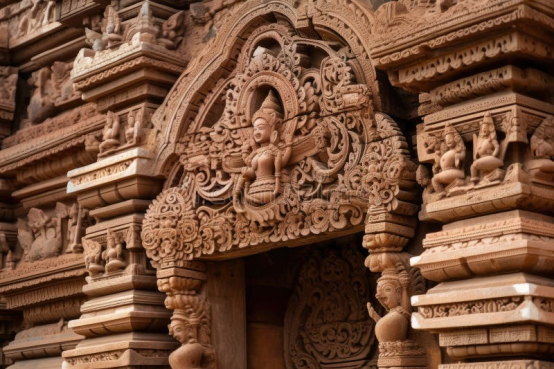
The charm of Hindu temple architecture lies in the symbolism behind their intricate designs and carvings. Each temple is like a miniature universe, reflecting the cosmology of Hinduism. The layout of the temple is often based on the mandala, a geometric pattern that represents the order and divine unity of the universe. The sanctum sanctorum is usually located in the center of the temple and is dedicated to the main deity, which is the most direct point of contact between believers and the gods. So, don’t these intricate designs convey a deep belief to us? It is not just a building, but also a spiritual carrier, an interweaving of life and faith.
The towers soar into the sky, symbolizing the loftiness of the holy mountain, as if announcing to the world: Here, the material world and the spiritual world meet. The entrance gate is both the beginning of the ceremony and the threshold between the material and the spiritual. Imagine, when you walk into this magnificent building, can you feel the sacred breath gushing from the altar? Every carved statue and every pattern depicting a mythological scene reminds you that entering here is not just a physical space, but a journey to the depths of the soul.

Sacred geometry and cultural heritage
For Hinduism, geometry is not only a mathematical tool, but also a path to truth. In the layout of the temple, the square represents human thought and knowledge, while the circle symbolizes the endless universe and everything in the world. Each small “pada” square carries a sacred symbol and even represents a certain god or element. Can you imagine the deep philosophy and cosmic laws contained between these squares and circles?
However, Hinduism does not have fixed religious doctrines or authority, nor does it have a holy book in the traditional sense. It is a pluralistic and open system where believers can choose polytheism, pantheism, monism, or even atheism. Do you think that this flexible religious structure makes people freer? Everyone’s spiritual journey is a personal choice and experience, just like the design of Hindu temples – it has no unified template, and each temple tells its own story and displays its own spiritual symbols.

Cave Temples: Divine Carvings in Rock
The rock-cut temples in India, especially the cave temples in Maharashtra, give people a different sense of mystery. Unlike ordinary temples, these temples are carved out of rocks. They are not simple buildings, but a perfect combination of nature and human wisdom. It is hard to imagine how artists present these magnificent temples and statues in the solid rock! For example, the Ellora Temple and the Elephanta Caves not only show the integration of Hinduism, Buddhism and Jainism, but also reflect the diversity and inclusiveness of Indian culture.
Each sculpture seems to be telling a mythological story, and every concave and convex part of the stone hides countless wisdom. The statues are full of power and tranquility, as if they are standing there, talking to history and believers. When you stand quietly in front of these sculptures, will you find that they are not only the crystallization of art, but also the carrier of philosophy and spirituality? Even the blank space on the wall has a profound meaning – it represents the ineffable Brahman, beyond all words and images.
Geometry: The mysterious language
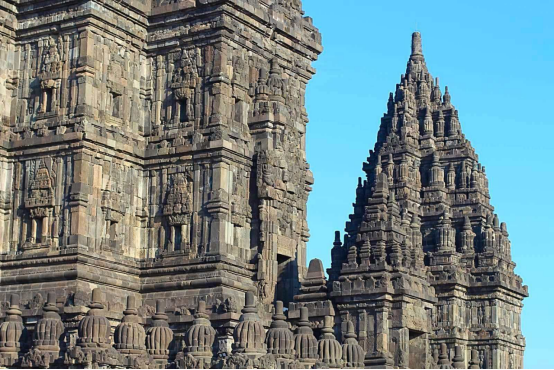
Geometric figures are everywhere. Fibonacci numbers, golden ratios, fractal structures, these seemingly modern mathematical concepts have actually been cleverly used in ancient Indian temple architecture. They are not just decorative elements, but represent the harmony and order that is everywhere in the universe. Patterns such as lotus, triangles, and circles appear repeatedly in every part of the temple. These shapes and symbols not only make people feel beautiful, but also silently convey sacred messages. They are “mantras” that echo in the air with silent prayers – wouldn’t this sacred vibration make you feel an incomparable tranquility in your heart?
Related Posts