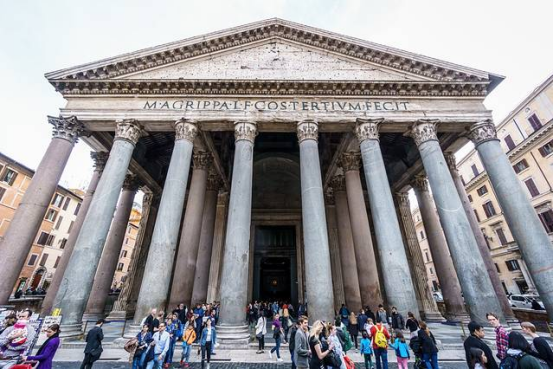
The Pantheon, an ancient building standing in the heart of Rome, Italy, is perhaps one of the most influential buildings in the world. Countless tourists come here to look up at the eye-catching dome with awe in their hearts. It is not only a pilgrimage site for architecture enthusiasts, but also carries profound historical and cultural significance. So, what is it that has allowed this ancient building to stand tall for thousands of years and attract the world’s attention?
History of the Pantheon: From Myth to Reality
When it comes to the Pantheon, many people may be curious about why this building is so unique? We can start with its name: “Pantheon” is Greek, meaning “Temple of All Gods”. From this name, we can get a glimpse of its original purpose – the Pantheon is a place to worship all gods.
The Pantheon we see today is not the original one. The earliest Pantheon was built in 25 BC by the Roman politician Marcus Agrippa, who, as the son-in-law of Emperor Augustus, put a lot of effort into the design of the building. However, the Pantheon did not remain intact. In 80 AD, a fire destroyed it, and it was rebuilt by the Roman Emperor Domitian, but unfortunately, it was destroyed again in 110 AD. It was not until the reign of Emperor Hadrian that the Pantheon appeared in front of the world in the form we see today.
Just imagine, after several disasters and hundreds of years of wind and rain, this ancient building still stands majestically. Such tenacious vitality is truly moving.
The Pantheon’s Dome: A Symbol of Architectural Wonder
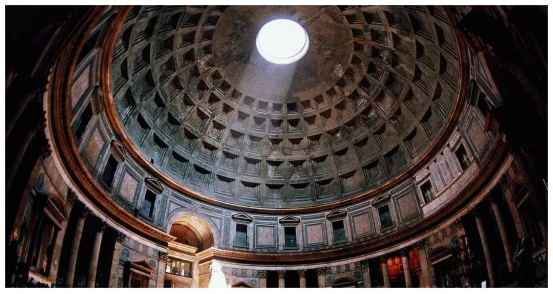
If you ask what is the most amazing thing about the Pantheon, the answer is undoubtedly its majestic dome. With a diameter of 142 feet (about 43 meters), there was almost no other similar building at that time that could match it. How did the ancient Roman architects complete such a magnificent project? Their wisdom is truly amazing.
There is a circular opening at the top of the dome, which is 27 feet (about 8 meters) wide. Through this opening, sunlight shines into the hall and air circulates freely. Although the weather changes, rain occasionally drifts in through this opening, but this is also part of the unique charm of the Pantheon. Imagine that the people of ancient Rome once felt the mysterious atmosphere of sunlight and raindrops falling here. This is not only a building, but also a kind of awe and integration of natural forces.
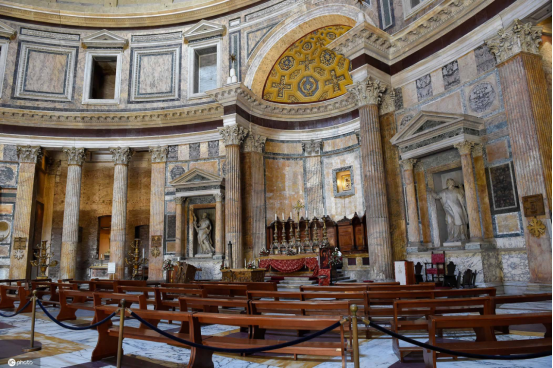
In addition, the walls and floors of the Pantheon are decorated with exquisite marble and gilding, and the luxury and exquisite details show the extraordinary craftsmanship of the Roman Empire. The 28 rectangular grids in the dome and the five ring structures all reflect the perfect understanding of space, light and mechanics in ancient Rome.
When Michelangelo stood in front of the Pantheon, he called it “the design of angels.” His amazement was a compliment to the building that transcended its time.
The Pantheon’s influence: an architectural symbol across time and space
The Pantheon’s design didn’t just influence the architects of ancient Rome. Its influence has transcended time and space and is deeply rooted in the history of Western architecture. During the Renaissance, architect Andrea Palladio was deeply inspired by it and created several classic architectural works. Even more surprising is that modern architecture has also drawn inspiration from the Pantheon. For example, the rotunda of the U.S. Capitol clearly imitates the design of the Pantheon.
Not only that, the design concept of the Pantheon also influenced US President Thomas Jefferson, who incorporated elements of the Pantheon when designing his Monticello residence in Virginia and the rotunda at the University of Virginia. To this day, the Pantheon remains a source of inspiration for architects and artists. It is not only a symbol of Rome, but also an architectural heritage that transcends culture, time and region.
The Pantheon Today: A Blend of History and Religion
Today, the Pantheon is not only a relic of ancient Rome, but also carries a profound religious significance. Since the end of the 7th century, it has been converted into a Christian church and has become a holy place for Catholics, where masses are held regularly. Although there are endless tourists, the building still retains its religious function and silently guards the city.
In addition, the Pantheon has become the resting place of many Renaissance celebrities, including the painter Raphael, the composer Arcangelo Corelli and the architect Baldassare Peruzzi. What is even more touching is that the great Italian monarch Vittorio Emanuele II, the first king of unified Italy, is buried here. The Pantheon has become a symbol of the Italian spirit, and every brick and stone of it seems to have witnessed the glory and changes of this country.
The Pantheon’s Building Materials: The Secrets of Ancient Roman Concrete
So how did the Pantheon achieve such a magnificent structure? The secret behind it is the Romans’ innovative concrete technology. The walls of the Pantheon are made entirely of Roman concrete, a mixture of volcanic ash, lime and fresh water. It is stronger and more durable than modern concrete. It is this special material that allows the Pantheon to support its huge dome and resist the erosion of time.
Have you ever wondered how the ancient Roman architects used this unique concrete technology to build a thousand-year-old architectural wonder? It is not only a masterpiece of architecture, but also a perfect combination of ancient wisdom and modern miracles.
Conclusion: An architectural legend spanning a thousand years
The Pantheon, an ancient building that has stood tall for thousands of years, is the pinnacle of ancient Roman architectural art. It is not only a building, but also a piece of history, a culture, and an eternal legend. Today, standing in front of the Pantheon, we seem to hear it whispering: “No matter how many years pass, my greatness and glory will never fade.”
It witnessed the glory of ancient Rome, and also witnessed the innovation and dreams of modern architects. No matter how the times change, the Pantheon will always occupy a place in our hearts and become an immortal legend in the history of architecture.

Related Posts