The human impulse to communicate, record, and transmit knowledge across generations is as old as civilization itself. Before the advent of formal writing systems, early humans relied on oral traditions, rudimentary symbols, and mnemonic devices to preserve their histories and cultures. This foundational need eventually blossomed into the complex tapestry of written languages that have shaped every aspect of human society. From the earliest pictograms etched onto cave walls to the sophisticated digital lexicons of the 21st century, the journey of writing and language is a testament to human ingenuity and our unceasing quest for understanding and connection.
This comprehensive guide delves into the profound history and intricate evolution of writing systems and languages. We will explore the revolutionary moments of their invention, dissect their critical functions in the rise and fall of ancient empires, trace the fascinating development of specific linguistic traditions such as Chinese and English, and highlight pivotal archaeological discoveries that continue to unravel the mysteries of our past. Understanding these trajectories offers not just a historical perspective, but a deeper appreciation for the bedrock upon which all modern knowledge and communication are built.
The Genesis of Writing: From Pictograms to Phonetics
The invention of writing stands as one of humanity’s most significant intellectual achievements, transforming ephemeral thoughts into permanent records. This monumental leap did not occur overnight but was a gradual evolution, beginning with simple representational forms and progressing towards abstract phonetic systems. The journey from capturing images to representing sounds fundamentally altered the trajectory of human civilization.
Early Precursors to Formal Writing
Before the development of true writing, various societies employed systems to convey information. These early precursors laid the groundwork for the more complex systems that would follow, demonstrating humanity’s innate drive to store and retrieve data beyond immediate memory.
- Cave Paintings: Found across the globe, these ancient artworks (e.g., Lascaux, Altamira) served not only as artistic expression but likely as a means of storytelling, ritualistic communication, or teaching. While not a writing system, they represent early visual communication.
- Tokens and Tallies: In Mesopotamia, clay tokens were used for accounting and record-keeping for agricultural goods as early as 8000 BCE. These evolved into more complex systems where tokens were enclosed in clay bullae, eventually leading to impressions on the bullae themselves, foreshadowing cuneiform.
- Quipu: The Inca civilization, lacking a phonetic writing system, utilized quipu—knotted cords—to record statistical and historical data. The type of knot, position, and color of the cords all carried specific meanings, demonstrating a sophisticated non-alphabetic information storage method.
Cuneiform: The First Script of Civilization
Emerging in Sumer, Mesopotamia (modern-day Iraq) around 3500-3000 BCE, cuneiform is widely recognized as the earliest known system of writing. Its development was intrinsically linked to the administrative and economic needs of burgeoning urban centers.
- Origin and Evolution: Initially, cuneiform began as a system of pictograms, simple drawings representing objects. As the need for faster and more abstract recording grew, scribes began using wedge-shaped styluses to press marks into wet clay tablets. This shifted the script from purely pictorial to a logophonetic system, combining word-signs (logograms) with syllabic signs.
- Administrative and Legal Applications: Cuneiform was extensively used for documenting transactions, inventories, and legal codes. The Code of Hammurabi, a well-preserved ancient Babylonian law code dating to about 1754 BCE, is a prime example of cuneiform’s role in establishing societal order and justice.
- Literary and Historical Records: Beyond practical uses, cuneiform preserved rich literary traditions. The Epic of Gilgamesh, one of the earliest surviving works of literature, offers profound insights into Sumerian mythology, philosophy, and heroism, demonstrating the script’s capacity for complex narrative.
Egyptian Hieroglyphs: Sacred Carvings and Complex Meanings
Co-evolving around 3200 BCE, Egyptian hieroglyphs presented a visually stunning and equally complex writing system. Often associated with monumental architecture and religious texts, hieroglyphs were much more than mere pictures.
- Nature of the Script: Hieroglyphs combined three types of signs:
- Logograms: Representing entire words or concepts (e.g., a drawing of a sun for ‘sun’).
- Phonograms: Representing sounds (consonants, as vowels were generally not written), which could be uniliteral (one sound), biliteral (two sounds), or triliteral (three sounds).
- Determinatives: Non-phonetic signs placed at the end of a word to clarify its meaning, especially for homophones.
- Forms of Egyptian Writing: While hieroglyphs were used for formal inscriptions, two cursive forms developed for everyday use:
- Hieratic: A simplified, priestly script used for administrative documents and religious texts on papyrus or ostraca.
- Demotic: An even more simplified and faster script, used for legal and business documents, and eventually for literary works.
- The Rosetta Stone: Discovered in 1799, this artifact was crucial for decipherment. It contained a decree issued in 196 BCE inscribed in three scripts: hieroglyphic, Demotic, and ancient Greek. Its parallel texts provided the key for Jean-François Champollion to unlock the secrets of hieroglyphs in 1822.
The Enigma of the Indus Valley Script
Flourishing between 2500 and 1900 BCE in what is now Pakistan and northwest India, the Indus Valley Civilization also developed a unique writing system. Found on seals, pottery, and small tablets, this script remains largely undeciphered to this day.
- Characteristics: It is primarily pictographic, with around 400-600 distinct symbols. The short nature of the inscriptions (averaging five signs) makes decipherment challenging, as there are no long texts or bilingual equivalents like the Rosetta Stone.
- Potential Implications: If deciphered, the Indus script could reveal profound insights into the religion, governance, and daily life of one of the world’s earliest major civilizations, potentially linking it to proto-Dravidian languages or other ancient linguistic families.

Writing’s Pivotal Role in Ancient Civilizations
The emergence of writing was not merely an intellectual curiosity; it was a transformative technology that directly enabled the rise and sustained complexity of ancient civilizations. It provided the scaffolding necessary for large-scale organization, the dissemination of knowledge, and the preservation of cultural identity. Without written records, the intricate administrative, economic, and social structures that define civilization would have been impossible to maintain.
Administration and Governance: The Foundation of Order
In sprawling empires and burgeoning city-states, effective governance demanded robust record-keeping. Writing provided the means to codify laws, manage vast territories, and ensure the smooth functioning of complex bureaucracies.
- Codification of Laws: Writing allowed for the creation of standardized legal systems, ensuring consistency and transparency. The aforementioned Code of Hammurabi is a prime example, providing a written framework for justice and societal norms. This prevented arbitrary rule and established a clear understanding of rights and responsibilities.
- Decrees and Edicts: Rulers could issue written decrees that were disseminated across their realms, ensuring that policies, taxes, and royal commands were communicated accurately and uniformly to diverse populations, from distant provinces to local villages.
- Treaties and Diplomacy: International relations, alliances, and peace treaties were formalized through written agreements, providing a lasting record and legitimizing diplomatic outcomes between different powers.
- Census and Taxation: Governments used writing to conduct population counts, assess taxable assets, and manage resource distribution, which was critical for funding public works, armies, and royal courts.
Economic Development: Facilitating Trade and Commerce
The growth of complex economies, particularly those involving long-distance trade and specialized labor, was heavily reliant on written documentation. Writing brought accountability and clarity to commercial transactions.
- Trade Records and Inventories: Merchants used written ledgers to track goods, sales, and debts. This enabled more efficient management of resources, facilitated long-distance commerce, and minimized disputes by providing undeniable proof of transactions.
- Contracts and Agreements: Written contracts formalized agreements between individuals or groups, whether for land leases, labor services, or large-scale construction projects. These documents provided legal recourse and stability in commercial dealings.
- Currency and Weights: The standardization of currency, weights, and measures could be documented and enforced through written laws, ensuring fair trade practices across different regions and fostering economic trust.
Religious and Cultural Preservation: The Soul of Society
Writing became the primary vehicle for preserving a civilization’s spiritual beliefs, historical narratives, and artistic expressions, ensuring their transmission across generations and contributing to a shared cultural identity.
- Sacred Texts: Major religions relied on written scriptures (e.g., the Vedas, the Egyptian Book of the Dead, early biblical texts) to codify their doctrines, rituals, and moral codes. This ensured the integrity and consistent interpretation of religious teachings.
- Myths and Histories: Epic poems, mythological narratives, and historical chronicles (like the Sumerian King List or early Chinese annals) were recorded, offering insights into societal values, origins, and the deeds of heroes and rulers. These narratives fostered a collective memory and identity.
- Literary Works: The creation and preservation of literature, from poetry to plays, allowed for the development of complex artistic traditions and the exploration of universal human themes, enriching the cultural fabric of societies.
Education and Knowledge Dissemination: Powering Progress
The ability to write facilitated the systematic accumulation and transfer of knowledge, leading to the establishment of educational institutions and the flourishing of intellectual pursuits.
- Scribes and Literacy: The specialized skill of writing gave rise to a professional class of scribes, who were highly valued for their ability to read and write. Scribes were central to administration, temple functions, and legal systems. Literacy, though often limited to elites, conferred significant power and status.
- Libraries and Archives: Ancient civilizations established vast libraries and archives (e.g., the Library of Alexandria, the Royal Library of Ashurbanipal at Nineveh) to store clay tablets, papyrus scrolls, and other written materials. These repositories became centers of learning, preserving knowledge in fields like astronomy, medicine, mathematics, and philosophy.
- Pedagogy: Writing allowed for the creation of textbooks, instructional manuals, and educational curricula, standardizing learning and enabling more efficient training of future generations of scholars, priests, and administrators.

The Evolution of Major Writing Systems and Languages
Once invented, writing systems and languages did not remain static; they underwent continuous transformation, adapting to new cultural contexts, technological advancements, and the influences of migration and conquest. This ongoing evolution has shaped the linguistic landscape of the world, leading to the diverse and complex systems we see today.
The Chinese Writing System: A 3000-Year Continuum
The Chinese writing system stands unique for its remarkable continuity and resilience, having evolved over three millennia while largely retaining its logographic core. It is the longest continuously used writing system in the world.
- Origins in Oracle Bone Script: The earliest substantial evidence of Chinese writing comes from the Shang Dynasty (c. 1600–1046 BCE) in the form of oracle bone inscriptions. These were divinations carved onto turtle plastrons and ox scapulae, primarily consisting of pictographic and ideographic characters. This early script already displayed many fundamental characteristics that would persist.
- Complexity and Evolution: Over centuries, the script evolved through various forms:
- Bronze Inscriptions (Jinwen): More elaborate and less pictorial than oracle bone script, used for ritual vessels.
- Seal Script (Zhuanshu): Standardized under the Qin Dynasty (221–206 BCE) by Emperor Qin Shi Huang as part of his unification efforts. This standardization was crucial for administrative control and cultural cohesion across a vast empire. Characters became more regular and stylized.
- Clerical Script (Lishu) and Regular Script (Kaishu): Developed during the Han Dynasty (206 BCE–220 CE), these forms became more practical and less cumbersome, leading to the “regular script” which is still the basis for modern printed Chinese characters.
- Logographic Nature and Cultural Impact: Unlike alphabetic systems, Chinese characters (hànzì) primarily represent morphemes (meaningful units) rather than sounds. This logographic nature has several profound implications:
- Cultural Unity: Despite vast regional dialectal differences (which can be mutually unintelligible), the shared written script has provided a powerful unifying force for the diverse Chinese civilization for thousands of years. A person from Beijing and a person from Guangzhou might not understand each other’s spoken language, but they can read the same newspaper.
- Learning Curve: The sheer number of characters (tens of thousands, with several thousand needed for basic literacy) makes learning to read and write Chinese a significant undertaking.
- Modern Simplifications: In the 20th century, particularly in mainland China, a movement towards character simplification was implemented to promote literacy, reducing the number of strokes in many common characters.
The Alphabet’s Rise: From Phoenicia to Greece and Rome
While logographic systems offered depth, the development of the alphabet represented a paradigm shift towards phonetic efficiency, making literacy more accessible and laying the groundwork for many modern languages.
- The Phoenician Alphabet: A Revolutionary Leap: Originating around 1200 BCE, the Phoenician alphabet was a purely consonantal system (an abjad) of about 22 letters. It was revolutionary because each symbol represented a single sound, drastically reducing the number of characters needed to write. This simplicity made it easy to learn and adapt, facilitating its spread across the Mediterranean through Phoenician maritime trade.
- Greek Adaptation: Adding Vowels: Around 800 BCE, the Greeks adopted the Phoenician alphabet, making a crucial innovation: they converted some of the Phoenician consonantal letters (for sounds not present in Greek) into vowel sounds. This creation of a true alphabet, where both consonants and vowels were represented, allowed for a more precise and unambiguous transcription of spoken language, significantly enhancing its expressive power. The Greek alphabet became the foundation for all subsequent Western alphabets.
- Latin Alphabet: The Imperial Spread: The Etruscans adapted the Greek alphabet, and in turn, the Romans adopted and modified the Etruscan script, creating the Latin alphabet. As the Roman Empire expanded, so did the Latin alphabet, spreading across Europe, North Africa, and parts of the Middle East. It became the basis for the writing systems of Romance languages (Italian, French, Spanish, Portuguese, Romanian) and Germanic languages (English, German, Dutch), among many others.
The Evolution of the English Language: A Tapestry of Influences
English, now a global lingua franca, has a rich and complex history, shaped by successive invasions, cultural interactions, and internal linguistic shifts. Its evolution is typically divided into three main periods:
- Old English (c. 450–1150 CE): Germanic Roots and Early Invasions:
- Anglo-Saxon Invasions: The arrival of Germanic tribes (Angles, Saxons, Jutes) from mainland Europe in the 5th century laid the foundation for English. Old English was a West Germanic language, characterized by a highly inflected grammar (similar to modern German) and a vocabulary rich in Germanic words.
- Viking Influence: Further invasions by Norse Vikings from the 8th to 11th centuries introduced many Old Norse words into English, particularly in areas of daily life, law, and place names (e.g., sky, leg, take, law).
- Key Text: Beowulf, the epic poem, is the most famous surviving work in Old English, showcasing its complex poetic and grammatical structure.
- Middle English (c. 1150–1500 CE): The Norman Conquest and French Infusion:
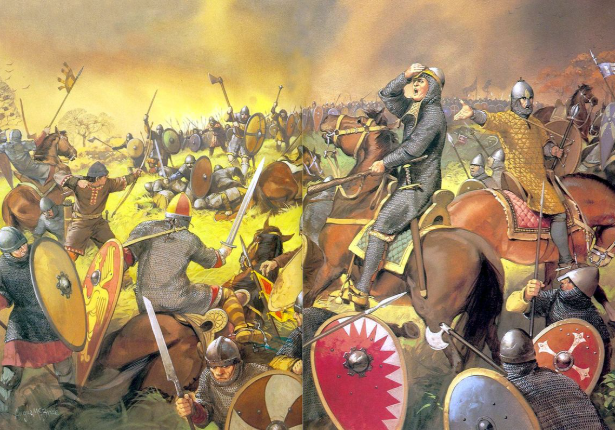
- Norman Conquest (1066): The invasion by William the Conqueror and his Norman French forces had a profound impact. French became the language of the court, administration, and law, while English remained the language of the common people. This bilingualism led to a massive influx of French (and Latin through French) vocabulary into English.
- Grammatical Simplification: During this period, English underwent significant grammatical changes, largely losing its complex inflections and moving towards a more analytical word order (similar to modern English).
- Key Text: Geoffrey Chaucer’s The Canterbury Tales is the quintessential work of Middle English, demonstrating the language’s emerging richness and flexibility, blending Germanic and Romance elements.
- Early Modern English (c. 1500–1800 CE): Printing, Renaissance, and Standardization:
- The Printing Press: William Caxton’s introduction of the printing press to England in 1476 was revolutionary. It helped standardize spelling and grammar, promoting the East Midland dialect (London-based) as the dominant form.
- The Renaissance: A renewed interest in classical learning led to a huge influx of Latin and Greek words, enriching English vocabulary, especially in academic, scientific, and medical fields.
- The Great Vowel Shift: A major phonological change occurred between the 14th and 18th centuries, where the pronunciation of long vowels in English shifted upwards and forwards in the mouth, explaining many of the irregularities between English spelling and pronunciation (e.g., the ‘a’ in ‘name’ versus ‘father’).
- Key Figure: William Shakespeare’s works (late 16th/early 17th century) represent the zenith of Early Modern English, showcasing its vast vocabulary and expressive power.
- Modern English (c. 1800–Present): Global Spread and Continuous Evolution:
- Colonial Expansion: The British Empire’s global reach led to English being established in North America, Australia, India, and many other parts of the world, giving rise to various regional dialects and new Englishes.
- Industrial Revolution and Technology: Rapid advancements brought new vocabulary into the language, particularly in scientific and technological domains.
- Digital Age: The internet and digital communication continue to drive rapid lexical innovation, with new words and phrases entering the language at an unprecedented rate, demonstrating English’s ongoing adaptability and dynamism.

Unveiling the Past: Discoveries of Ancient Inscriptions
Archaeological discoveries of ancient inscriptions are critical windows into lost worlds. Each unearthed tablet, carved stone, or painted scroll offers direct evidence of past human thought, culture, and history. These findings not only confirm existing historical narratives but frequently challenge them, pushing the boundaries of our understanding and revealing entirely new civilizations or linguistic branches.
Archaeological Significance: Reshaping Our Understanding
The significance of new inscription discoveries cannot be overstated. They provide primary source material that can offer unparalleled insights into various aspects of ancient societies:
- Chronology and Historical Events: Inscriptions can provide precise dates for events, names of rulers, and details of political or military conflicts, helping to construct more accurate historical timelines.
- Linguistic Evolution: Undeciphered scripts or new examples of known languages can shed light on linguistic family trees, dialectal variations, and the development of phonology and grammar over time.
- Cultural and Religious Practices: Texts often describe rituals, beliefs, myths, and daily life, providing direct evidence of societal norms, values, and spiritual worldviews that cannot be gleaned from artifacts alone.
- Economic and Administrative Systems: Ledgers, contracts, and decrees reveal details about trade networks, taxation, property ownership, and the organization of labor within ancient economies.
Case Study: Unknown Inscriptions Near Lake Bashprim
Recent hypothetical discoveries, such as the unknown ancient inscriptions near Lake Bashprim, exemplify the excitement and challenges inherent in deciphering new linguistic puzzles. While this specific discovery is illustrative, it mirrors real-world scenarios faced by epigraphers and linguists.
- Context of Discovery: Imagine a team of archaeologists working in a remote, previously unexplored region near Lake Bashprim unearths a series of stone tablets and carved stelae. These artifacts bear a script unlike any previously identified, suggesting the existence of a hitherto unknown civilization or a distinct branch of an established one. The inscriptions are found within what appears to be a ceremonial complex, hinting at a strong religious or ritualistic context.
- Challenges of Decipherment: The process of deciphering an unknown script is arduous and often takes decades, sometimes centuries. Key challenges include:
- Lack of Bilinguals: Unlike the Rosetta Stone, most new discoveries lack parallel texts in known languages, making initial breakthroughs extremely difficult.
- Limited Corpus: Often, only a small number of inscriptions are found, providing insufficient data for statistical analysis or pattern recognition. The Bashprim inscriptions might present a limited, fragmented corpus.
- Unknown Language Family: Without knowing the underlying spoken language, it’s hard to determine if the script is logographic, syllabic, or alphabetic, or a combination. The Lake Bashprim script might belong to an extinct language family with no modern descendants.
- Cultural Context: Understanding the cultural context and purpose of the texts is crucial. Are they religious, administrative, historical, or poetic? The ceremonial complex at Bashprim suggests a ritualistic purpose, which could guide interpretation.
- Potential Insights: If successfully deciphered, the Lake Bashprim inscriptions could offer revolutionary insights:
- New Civilization: The revelation of a distinct, sophisticated culture previously unknown to history.
- Linguistic Connections: Evidence of a new language family or unexpected connections between existing ones, altering our understanding of ancient migrations and linguistic diffusion.
- Unique Worldview: A glimpse into unique religious beliefs, social structures, or scientific knowledge that could challenge prevailing theories about ancient human development in the region.
Technological Advancements in Decipherment
Modern technology is increasingly playing a vital role in aiding the decipherment of ancient scripts, accelerating processes that once relied solely on painstaking manual effort.
- Digital Imaging and Photogrammetry: High-resolution digital photography and 3D modeling (photogrammetry) allow scholars to examine inscriptions in unprecedented detail, revealing faint marks or difficult-to-read segments without damaging the original artifacts. This is particularly useful for fragmented or weathered texts.
- Computational Linguistics and AI: Artificial intelligence and machine learning algorithms are being developed to analyze patterns, frequencies, and relationships between symbols in undeciphered scripts. While not yet capable of fully deciphering a script independently, these tools can identify potential grammatical structures, recurring phrases, and statistical regularities, significantly narrowing down possibilities for human scholars.
- Multispectral Imaging: This technique can reveal faded or overwritten texts by capturing images across different light spectra, making previously invisible ink or carvings readable.

Post navigation


Related Posts