Hagia Sophia, a building standing in Istanbul, is not only the pinnacle of ancient engineering technology, but also a witness to the conflict and integration of Eastern and Western cultures and religions. From a Christian church to a mosque, then to a museum, and now back to being a mosque again, the history of Hagia Sophia can be said to be a historical drama spanning thousands of years. Every brick, tile, and pillar seems to be telling a different cultural story.
The wonder of the vault: the wisdom of ancient engineering
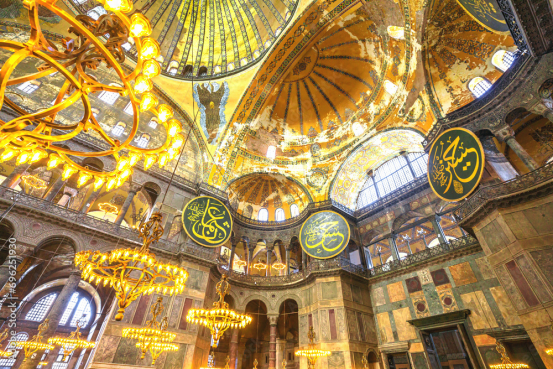
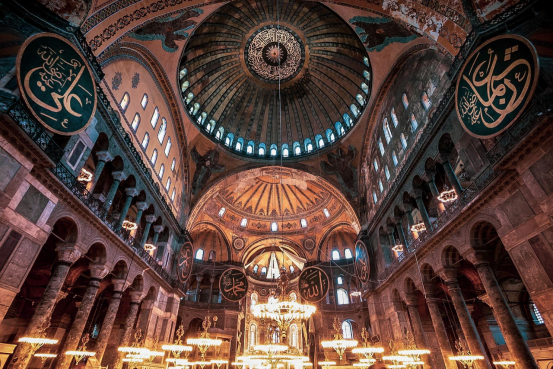
The most praised feature of this building is undoubtedly its magnificent dome. Looking around, the dome stands like a shining gem above the ancient city. Can you imagine how such a huge dome could be supported without modern construction technology? It was an ultimate challenge to human engineering wisdom! This miracle of Byzantine architecture was undoubtedly a huge breakthrough at the time, and it also made people marvel at the infinite creativity and bold imagination of architects.
When you stand inside the Hagia Sophia, and look across the intricate mosaics and exquisite decorative patterns, it’s as if you are in a space beyond time and space. The Byzantine art style and Islamic elements are intertwined. This collision and fusion of cultures is so shocking! The magnificence of Byzantium and the simplicity of Islam complement each other, and the sacredness and beauty have reached an unprecedented harmony here. Has anyone ever made you realize that the Hagia Sophia is not only a miracle of architecture, but also a miracle of culture and faith?
Structure and Materials: A Solid Foundation
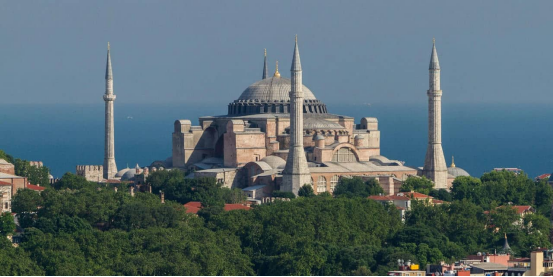
How did its architectural design do that? How did it hold up this massive building and stand for a thousand years? Four main structural engineering principles form the cathedral’s rock-solid foundation. First, the central dome is supported by arches and overhangs, forming a seemingly impossible structure that creates a wide, empty interior space. Who would have thought that without modern reinforced concrete, the weight of the dome could be distributed so cleverly and the entire structure so stable?
Next, the design of buttresses and semi-domes also provided additional support for Hagia Sophia. The outer supports of the buttresses helped to offset the lateral pressure from all directions; while the semi-domes shared the weight of the dome. How could the architects at that time have predicted that these seemingly simple structures could support an almost unimaginable architectural masterpiece?
Speaking of materials, Hagia Sophia uses stone, brick and other building materials, which not only give the building a strong structural strength, but also allow it to stand proudly after experiencing countless storms. Doesn’t it make people wonder: how does time carve out the soul of a building? It is not just relying on the advanced technology at the time, but is gradually endowed with the weight of history through the polishing of these annual rings.
The History of Hagia Sophia
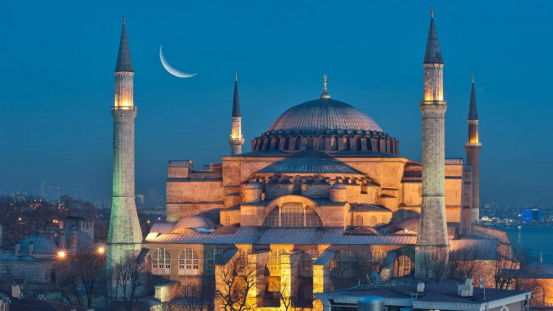
However, did you know that Hagia Sophia did not stand tall like this from the beginning? In fact, the history of Hagia Sophia has undergone three important reconstructions. The first church was built in Constantinople in 360 AD, but less than 50 years later, it was reduced to ashes in riots. The second church did not escape the same fate. Each destruction seemed to challenge human determination and faith. But it was between these failures and reconstructions that Hagia Sophia of Justinian the Great was built, a pinnacle of ancient architectural art.
Witness of history: No matter how the name changes
Regardless of its historical background, Hagia Sophia has never lost its glory. It has witnessed the changes of Christianity, Islam and various cultures. Since Turkish President Mustafa Kemal Ataturk converted it into a museum in the 20th century and then converted it back into a mosque in 2020, Hagia Sophia has never been forgotten by history. No matter how its name and identity change, Hagia Sophia still stands on this land, becoming a symbol of the intersection of cultures from all over the world.
Conclusion: Cultural heritage across time and space
Hagia Sophia is not just a building, it is a history, a belief, and a cultural symbol that spans thousands of years. Its magnificence and beauty bear the intersection and conflict of Eastern and Western civilizations. Every stone and every pillar silently tells unknown stories. And we, standing in front of this cathedral, seem to be touching the depth of human history and culture.

Related Posts