Sir Edwin Arnold, the famous English poet, aptly summed up the beauty of the Taj Mahal: “Not a building like any other, but a proud passion of the Emperor’s love crystallized in living stone.
The Taj Mahal in India is known as one of the wonders of the world and is the epitome of true love and passion. The Taj Mahal was built by the famous Mughal Emperor Shah Jahan in memory of his beloved wife Mumtaz Mahal. The architectural beauty and grandeur of the Taj Mahal has never been surpassed.
Shah Jahan poured his passion and wealth into the creation of such a monument. It is said that 20,000 stone carvers, masons, and artists from all over India and as far away as Turkey and Iraq were employed by a team of architects to build the Taj Mahal in lush gardens on the banks of the Jamuna River in Agra. They completed this epic task between 1631 and 1648.
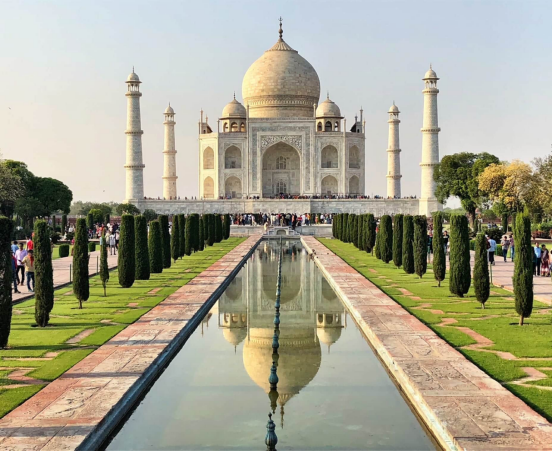
While the clean white marble arched domed outlines have become iconic, the Taj Mahal’s meticulous details also reflect other beauties: inlaid semi-precious stones and carvings and Quranic verses in calligraphy create a fascinating interior where Shah Jahan visited his wife’s body and was eventually buried beside her.
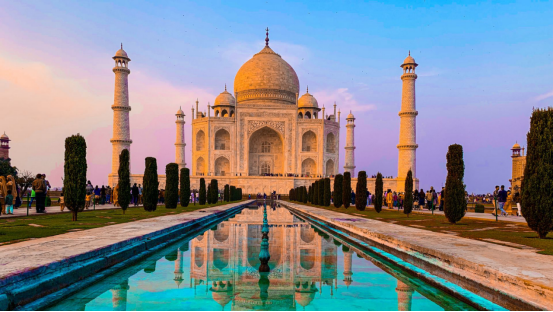
The Taj Mahal’s familiar marble dome is framed by four minarets from which Muslims are called to pray. Each tomb is designed to lean slightly outward, presumably to protect the main mausoleum in case one of them collapses. Set in lush gardens and complete with a huge reflecting pool, the structures regularly do what no human could ever accomplish – replicate the beauty of the Taj Mahal.
The interior of the Taj Mahal is dominated by a cavernous octagonal central chamber, from which eight smaller chambers radiate outward. The smaller chambers are spread over two floors, with a total of 16 such niches. The central burial chamber is the main funeral chamber, and contains the cenotaphs of Mumtaz Mahal and Shah Jahan. The two ornate marble cenotaphs are enclosed in marble screens and face south. Below the tomb where the actual sarcophagus lies is a relatively simple crypt.
Although Islam at the time prohibited elaborate decoration of tombs, Shah Jahan ornately ignored the order and commissioned ornate detailing of the interior surfaces. Pietra dura and gemstone inlays decorate the floors as well as the wall and floor work. A large number of gemstones and colored stones were used in the design. The highly polished surfaces reflect the light that filters through the marble lattices in the windows and arches. The tomb itself bears a calligraphic inscription of the 99 names of God, and on Shah Jahan’s tomb, an additional paragraph is inscribed in impeccable calligraphy that reads “He came from this world to the eternal banqueting hall on the evening of the 26th of the month of Rajab, 1076 Hijri.”
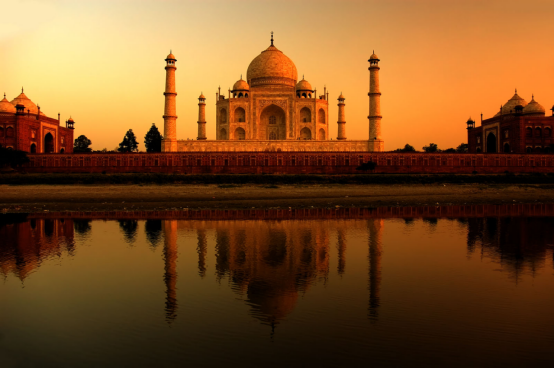
The Taj Mahal is a perfectly symmetrically planned building, emphasizing bilateral symmetry along the central axis, on which the main features are located. The building materials used are lime brick mortar with veneers of red sandstone and marble, and inlay work of precious/semi-precious stones. The mosque and guest house in the Taj Mahal complex are built of red sandstone, in contrast to the marble tomb in the center. Both buildings have a large platform on the front terrace. Both the mosque and the guest house are identical structures. They have a huge rectangular prayer hall consisting of three arched bays arranged in a row with the main portal in the center. The frames of the portal arches and spandrels are veneered with white marble. The spandrels are covered with floral stone intarsia arabesques and the arches are bordered with rope moldings.
This exquisite marble building in Agra, India, is a mausoleum, a lasting monument to a husband’s love for his favorite wife. It is also a lasting testament to the artistic and scientific achievements of a wealthy empire.

Related Posts